
Version française disponible ici.
Details on the criteria used in this page can be found here.
Opinel hasn't used as many woods to make number 6 models as it has to make number 8 models. Yet a few number 6 models are made of high quality woods such as tulipwood, rosewood or boxwood.
Due to a smaller diameter of the ferrule-virobloc system and a shorter blade, hardware inspection is less obvious on number 6 models than it is on number 8 models. Differences nevertheless exist. The hardware rating is thus kept even though it may seem excessive.
In addition, I haven't seen a number 6 model whose ferrule fully overlays the wood. Consequently, the 3/3 hardware quality rating is never granted. The best hardware quality rating a number 6 model can get is 2a/3.
To the best of my knowledge, Opinel has never provided information on the number of copies manufactured for number 6 models. Besides no model has been numbered.
The value of some number 6 models are two to four times lower than those of number 8 models made of the same wood. Catching-up might be expected. Especially since Opinel has stopped manufacturing models made of fine woods.
Beech (Hêtre)
The Beech model constitutes the core of the current Opinel number 6 production. Tens of thousands of copies have been manufactured. The copies are delivered in bulk, in a pillow box, or in plastic packaging. The blades are stainless or carbon steel.
Year of production: NA
Wood quality: 2/5
Hardware quality: NA
Rareness: 1/5
Value: €12
Value change: =
Boxwood (Buis)
The Boxwood model was manufactured for a few years in small quantities. Today it seems that the production has ceased. Long available, the model has become rare. It is delivered in a pillow box. A few copies were delivered in a cardboard drawer box. The blade is stainless steel and not polished.
Year of production: before 2016
Wood quality: 4/5
Hardware quality: 2a/3
Rareness: 4/5
Value: €30-€50
Value change: +

Bubinga
As with the number 8, the production of number 6 copies made of bubinga was significant. It kept on until Opinel replaced bubinga with padouk.
The Bubinga copies were delivered in a blue cardboard box with a corner sticker, a sheath and a leaflet, in a cardboard drawer box with a sheath and a leaflet, in a cardboard drawer box with a red molded bottom, or in an oak case with red molded bottom and a leaflet.
With the first runs, OPINEL and the crowned hand were printed out on the varnished handles. Next the handles lost the imprint and the varnish with the latest runs.
The blades are stainless and polished. Several markings were used over the years : laser etching on the first runs then stamping on the next ones.
Year of production: before 2016
Wood quality: 3/5
Hardware quality: 2ab/3 to model in cardboard drawer box with a red molded bottom
Rareness: 3/5
Value: €25-€40
Value change: =
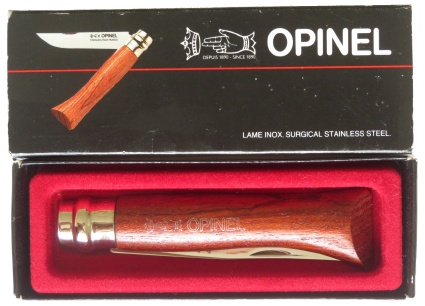
Chaperon
The Chaperon models were produced in two or three series. Several woods are glued together along curved surfaces. The difference between the series lies in the wood species used. The first series puts together South American and African woods. The last series adds European woods.
The Chaperon copies were delivered either in a pillow box, or in a tan cardboard box with a sheath, or in a blue cardboard box with a corner sticker and a sheath. A leaflet may be included. The blades are all stainless and polished.
Chaperon number 6s are less available than Chaperon number 8s. In addition, Opinel may have stopped manufacturing them.
Year of production: before 2012 (?) for the first series
Wood quality: NA
Hardware quality: 2a/3 before 2016
1/3 after 2016
Rareness: 5/5
Value: €40-€60
Value change: =

This Chaperon puts together four woods. The fourth one is located on the other side of the handle. Chaperon number 6s glue together three or four different woods. Three-wood Chaperon number 6s may be more frequent than three-wood Chaperon number 8s.
Oak, European (Chêne pédonculé)
The production of the European oak model keeps on. Thousands of copies have been manufactured. The model is delivered in a pillow box. The blade is stainless.
The Oak model was one of the Bois de France.
Year of production: NA
Wood quality: 1/5
Hardware quality: NA
Rareness: 1/5
Value: €17
Value change: =

Olive (Olivier)
The production of the olive model keeps on. Thousands of copies have been manufactured. The model is delivered in a pillow box. The blade is stainless.
The Olive model was one of the Bois de France.
Year of production: NA
Wood quality: 4/5
Hardware quality: NA
Rareness: 1/5
Value: €17-€40
Value change: =

Padauk (Padouk)
The Padauk model replaced the Bubinga model. Production is currently going on. It comes in a blue cardboard box with corner sticker, leaflet and sheath. The blade is stainless and polished.
Year of production: after 2017
Wood quality: 2/5
Hardware quality: 1/3
Rareness: 2/5
Value: €23
Value change: =

Padauk gets tan or brown with age. The hardware being standard, the items sold with the knife should be kept.
Rosewood (Palissandre)
The production of the Rosewood model spans over years. The first copies were made of Honduran Rosewood then Opinel substituted it with East Indian Rosewood. The Rosewood models were delivered in a pillow box, in a cardboard drawer box, in a tan cardboard box with a leaflet, or in an oak case with red molded bottom with a "Palissandre" sticker for a few copies. The blades are always stainless and polished. They bear several markings used by Opinel.
Oddly enough, the handles of the rosewood model were cut narrower than the handles of the other models. Three details are particularly notable. One, the heel width of the rosewood model is shorter than that of the other models. Two, the distance between the end of the slot that accommodates the blade and the tip of the heel is almost non-existent on the rosewood model. Three, the visible part of the folded blade of the rosewood model is larger than on the other models. The image below shows these differences.
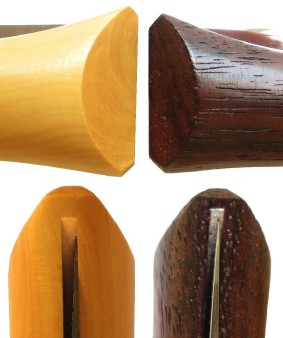
The explanation for the difference in the structure of the rosewood handles is unknown to me.
Year of production: before 2006
Wood quality: 3/5 or 4/5
Hardware quality: 2a/3
Rareness: 4/5
Value: €40-€70 according to the delivery
Value change: +

A copy made of Honduran rosewood up, a copy made of East Indian rosewood down.
Tulipwood (Bois de rose)
It would seem that there was a single production run made of tulipwood since all the blades bear the same stamp. Most of the copies were delivered in a pillow box. A few copies were delivered in a cardboard drawer box. A round sticker on the drawer reads "BOIS DE ROSE" to distinguish it from other models delivered in the same box. A very few copies were delivered in an oak case with leaflet and sheath. All copies have polished stainless steel blades.
The number of manufactured copies is unknown. Yet it seems unlikely that the number of marketed copies exceeded a few hundred. In any case, this model is the rarest of the number 6 models.
Year of production: [2006;2015] (?)
Wood quality: 4/5
Hardware quality: 2ab/3
Rareness: 5/5
Value: €90-€120 according to the delivery
Value change: +

Walnut (Noyer)
The production of the walnut model keeps on. Thousands of copies have been manufactured. The model is delivered in a pillow box. The blade is stainless.
The Walnut model was one of the Bois de France.
Year of production: NA
Wood quality: 1/5
Hardware quality: NA
Rareness: 1/5
Value: €17
Value change: =

Workshop (Atelier)
The Workshop model consists of a walnut body and an ebony heel separated by a very thin maple strip. It is delivered in a blue cardboard box with a corner sticker and an explanatory sheet. The blade is stainless.
To this day, it seems the production of the Workshop model number 6 has ceased.
Year of production: NA
Wood quality: 1/5 and 5/5
Hardware quality: 1/3
Rareness: 4/5
Value: €30-€60
Value change: =

Other woods
To the best of my knowledge, Opinel hasn't used any other woods to make number 6 knives. Curiously, notwithstanding five number 8 models made of ebony, there appears to have been no marketed number 6 made of ebony.
Yet since number 6 models also gave rise to the Bois de France series, there may have been a number 6 model made of ash but I've never seen any.
Opinel is a registered trademark.
© 2026 - coteopinel - All rights reserved