
Version française disponible ici.
Details on the criteria used in this page can be found here.
Only models made of wood species that have been produced in at least a hundred copies are considered in this document. Besides, models made of wood species that have not been marketed to a wide public are not evaluated here.
Apple (Pommier)
Apple wood gave rise to the manufacture of 200 copies for the 120th anniversary of the Chapuy hardware store. The model comes in a blue cardboard box with a round sticker and an explanatory sheet. The blade is stainless and polished. Besides, the texts "1905 2025", "LA QUINCAILLERIE CHAPUY", and "120 ans" are laser-etched on the blade.
The copies are not numbered.
Year of production: 2025 - 200 copies
Wood quality: 2/5
Hardware quality: 1/3
Rareness: 5/5
Value: €200-€250
Value change: +
Remark : This model is an event issue. It is only listed on this page because it is, to the best of my knowledge, the unique Opinel model made of apple wood.
Ash (Frêne)
The Ash model had a long production in the past. Thousands of copies were manufactured in the 20th century. It seems the production has become scant today and the old copies are almost impossible to get in new condition.
The model was delivered in bulk, in a pillow box or even in an oak case with a sheath. The blades were carbon steel in the past; they are stainless steel today.
None of the copies have been numbered.
The Ash model was one of the Bois de France. It also gave rise to the Animalia and Musée Opinel special series.
Year of production: NA
Wood quality: 2/5
Hardware quality: NA
Rareness: 3/5
Value: €30-€60
Value change: =

Beech (Hêtre)
The Beech model constitutes the core of the current Opinel production. The model is delivered in bulk, in pillow box, in plastic packaging or even in a beech pencil case with a leather case and leaflet. Tens of thousands of copies have been manufactured. The blades are stainless or carbon steel.
In 1998, beech was used to make a limited series called An Instrument of Nature. The knife was delivered in a square cardboard box with a whetstone, a beech blank, and a little guide. This series is not only hard to get but also very hard to find in fine condition.
Year of production: NA for the common model
1998 for An Instrument of Nature
Wood quality: 2/5
Hardware quality: NA to the common model
(?) to An Instrument of Nature
Rareness: 1/5 to the common model
5/5 to An Instrument of Nature
Value: €12 for the common model
€200-€300 to An Instrument of Nature
Value change: = to An Instrument of Nature

Beli
The Beli model comes in a blue cardboard box with a corner sticker. The box contains an explanatory sheet and a sheath. The blade is stainless and polished.
The model was manufactured in 3,500 copies. Yet it should be noted that Opinel had produced similar copies under the name Zebrali in 2007. The number of released copies is therefore greater than 3,500.
The zebrali model was delivered in a cardboard drawer box. A round sticker on the drawer reads "ZÉBRALI" to distinguish it from other models delivered in the same box. Since zebrali is another name for beli, the value of the zebrali model is at best equal to the blue boxed copies.
The copies are not numbered.
Year of production: 2007 and 2020 - more than 3,500 copies
Wood quality: 2/5
Hardware quality: 1/3
Rareness: 2/5
Value: €60-€80
Value change: =

Birch - Dyed or pigmented laminated birch (Bouleau lamellé teinté ou pigmenté)
There are several models in laminated birch. The models have been produced in different pairs of colors by Opinel or on behalf of Nature&Découvertes. Those produced for Nature&Découvertes were manufactured in a few hundred copies and those manufactured by Opinel for itself in a few thousand.
Most of the models are delivered in a tan or blue cardboard box with sometimes an explanatory sheet. The blue boxes often have an identifying corner sticker.
The blades are all stainless. The special series have a polished blade.
At least five series bear a particular name: Lamellé ardoise (3,500 copies), Lamellé brun noir (500 copies), Lamellé noir N&D (1,000 copies?), Old School, and Tangerine (500 copies). The 2012 Lamellé noir N&D model is delivered in a beech pencil case with a leaflet and a leather case.
None of the copies have been numbered.
Year of production: 2000 (?) - 2021
Wood quality: 1/5
Hardware quality: 1/3 after 2016
Rareness: 1/5 to the red, grey, or brown models
4/5 to Old School, Lamellé ardoise, and Lamellé brun noir
5/5 to Tangerine and Lamellé noir N&D
Value: €35 for red, grey, or brown models
€80-€100 for the Lamellé ardoise model
€100-€200 for the Old School model
€150-€350 for the Lamellé noir N&D and Lamellé brun noir models
€350-€400 for the Tangerine model
Value change: =

This is a Tangerine copy. Birch is a white wood. Thus all the colored strips (red, gray, brown, tan, black) forming the handle were dyed in the mass before being glued together. Only white strips show the true birch wood color.
Birch, Mazur - Sampo (Bouleau madré - Sampo)
The Sampo model is made from a figured birch that grows in Karelia. Its name is Mazur Birch or Karelian Birch. The model comes in a white/blue cardboard box with an explanatory sheet. The lid is illustrated with birch trunks. The blade is stainless and polished.
The model was produced in 6,750 copies. The copies are not numbered.
Year of production: 2022 - 6,750 copies
Wood quality: 1/5
Hardware quality: 1/3
Rareness: 1/5
Value: €50-€150 according to the figure richness
Value change: =

Blackwood, African (Grenadille)
The African Blackwood model comes in a blue cardboard box with an explanatory sheet and a sheath. The blade is stainless and polished.
The model was produced in 3,500 copies. The copies are not numbered.
Year of production: 2016 - 3,500 copies
Wood quality: 5/5
Hardware quality: 2a/3
Rareness: 4/5
Value: €120-€160
Value change: =

Although African Blackwood is sometimes called African ebony, it is not an ebony. The wood quality of African blackwood is superior to that of true ebonies.
Boxwood (Buis)
The Boxwood model has been produced for years and still is to my knowledge. However, it seems the production occurs in fits and starts. Whatever, the production remains low and the model is not so easy to find. The model is delivered in a pillow box. The blade is stainless steel and not polished.
None of the copies have been numbered.
Several event or thematic series were made of boxwood, for example France 98 or Légende des montagnes.
Year of production: NA
Wood quality: 4/5
Hardware quality: NA
Rareness: 3/5
Value: €40-€90
Value change: =

Bubinga
The production of Bubinga models was significant. It kept on until Opinel replaced bubinga with padauk.
The Bubinga series were delivered in blue cardboard boxes with a corner sticker and a sheath, in cardboard drawer boxes with sheath and leaflet, in cardboard drawer boxes with red molded bottom, or in plywood/fir cases with red molded bottom. "OPINEL" and the crowned hand were printed out on the varnished handles with the first runs. Next the handles lost the imprint and the varnish with the latest runs.
The term bubinga is a generic name that may cover eight species at least. Given the variety of handles produced over the years, it is likely that Opinel used different species. These diverse aspects mean that copies made of bubinga are sometimes mistaken for other species used by Opinel. The most frequent mistake is with rosewood. Tulipwood may also be incorrectly stated. However the value of the bubinga model is twice as low as that of the rosewood model and almost ten times lower than that of the tulipwood model.
The blades are stainless and polished. Several markings were used over the years : laser etching on the first runs then stamping on the next ones.
No series was numbered.
Year of production: before 2016
Wood quality: 3/5
Hardware quality: NA
Rareness: 3/5
Value: €40-€70
Value change: =
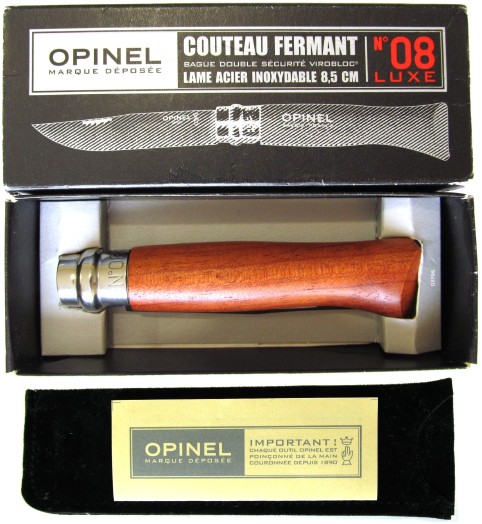
Chaperon
The Chaperon models were produced in two or three series. Several woods are glued together along curved surfaces. The difference between the series lies in the wood species used. The first series puts together South American and African woods. The last series adds European woods.
The Chaperon copies are delivered in a blue cardboard box with a corner sticker and a sheath or in a tan cardboard box with a sheath. A leaflet may be included. Copies in a canvas pouch with a cotton lace were also marketed. The blades are all stainless and polished.
The copies have not been numbered.
Considering the frequency of their appearance on sales sites, a production of several thousand copies seems to be a reasonable estimate.
Year of production: before 2010 (?) for the first series
Wood quality: NA
Hardware quality: NA
Rareness: 1/5
Value: €97 (€50-€70)
Value change: =

This Chaperon features four wood species. A Chaperon number 8 usually glues together four different woods. Three-wood, exceptionally two-wood, Chaperon can be found but they are not common.
Checkmate (Échec et mat)
The Checkmate model has a laminated handle made up of ebony slices alternating with thin strips of Castelo boxwood. It comes in a tan cardboard box with an explanatory sheet. The blade is stainless and polished.
1,500 copies were numbered. Yet the number of manufactured copies is unknown because numberless copies were made. The numbered copies are numbered parallel to the blade.
Year of production: 2011 - more than 1,500 copies
Wood quality: 2/5 and 5/5
Hardware quality: 3/3
Rareness: 5/5
Value: €500-€800 for numbered copies
€200-€250 for numberless copies
Value change: +

Cherry (Merisier)
Cherry wood was among the first woods used by Opinel to make their knives at the end of the 19th century. Thousands of copies were then made. There are still some copies left from this period. The ferrule didn't have a safety ring.
Since the 1990s, cherry wood production has only given rise to a few special series, including a replica of the 1890 model.
The 1890 replica model was manufactured in 2010 on the 120th anniversary of the Opinel brand. The handle is made of cherry wood and the blade is carbon steel. It comes in a tan cardboard box with a leather sheath stamped "OPINEL 1890" and an explanatory sheet. However, that replica does not conform to the model manufactured in 1890; in particular, the blade does not have the false edge that the first models had.
The replica production run would have been 2,000 copies but the whole run would not have sold. The remaining copies would have been recycled to other series. For example, apart from an etching on the handle ("Albiez le Vieux, berceau de l'Opinel / Place Opinel"), a printed box ("Albiez Montrond, le 7 août 2011 / Inauguration de la Place Opinel"), and a different explanatory sheet, the "Inauguration de la Place Opinel" model would be similar to the 1890 model. The "OPINEL 1890" stamped leather sheath is even included in the box.
The number of copies of the replica in circulation would thus be equal to 2,000 less the number of recycled copies.
Year of production: late 19th and early 20th century
2010 for the replica - less than 2,000 copies
Wood quality: 1/5
Hardware quality: NA
Rareness: 5/5 to the first copies
3/5 to the replica
Value: €60 for a restored first copy
€90-€120 for the replica
Value change: = to the replica

Ebony, Gabon (Ébène du Gabon)
The Gabon Ebony model keeps being manufactured. Thousands of copies have been made. Copies have been available in tan cardboard boxes with a leaflet, in blue cardboard boxes with a corner sticker, a leaflet and a sheath, or in oak cases with an "ÉBENE" sticker, a leaflet and a sheath. An oak case version added a number 2 made of ebony too. The blades are always stainless and polished.
Since the Gabon ebony model has been manufactured for many years, the hardware differs according to the year of making. So it is worth noting that the copies prior to 2016 sold in a tan cardboard box or in an oak case have the previous ferrule-virobloc system better adjusted than the notched ferrule-virobloc system of the later copies in blue cardboard boxes.
None of the copies have been numbered.
Year of production: NA
Wood quality: 5/5
Hardware quality: 2a/3 before 2016
1/3 after 2016
Rareness: 1/5
Value: €87 (€50-€70)
Value change: =

Ebony, Gabon - Ellipse (Ébène du Gabon - Ellipse)
The Ellipse model is a Gabon ebony model whose handle consists of two parts joined with an aluminium foil. The model comes in an oak pencil case with sheath and leaflet. The blade is stainless.
There are numbered copies on which the numbering evidences a production run of 4,000 copies. The numbering is perpendicular to the blade. However, most copies in circulation are not numbered. These therefore seem to be more numerous than the numbered copies.
Year of production: since 2020 - more than 4,000 copies
Wood quality: 5/5
Hardware quality: 1/3
Rareness: 1/5
Value: €92 (€60-€80)
Value change: =

Ebony, Gabon - Forge (Ébène du Gabon - Forge)
The Forge model is a sort of rustic Gabon ebony model. It comes in a gray/blue cardboard box with a lid knife painted and crossed by a blue band. The box includes an explanatory sheet. Ferrule and virobloc are stainless and black. The blade is made of carbon steel. Reproducing a wrought blade, they are all similar. The handles also look very similar.
The production run is limited to 6,000 copies. The copies are not numbered.
Year of production: 2024 - 6,000 copies
Wood quality: 5/5
Hardware quality: 1/3
Rareness: 2/5
Value: €120-€150
Value change: =
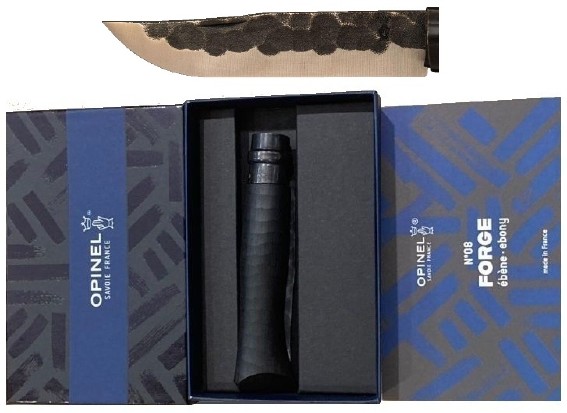
Ebony, Gabon with Damascus blade (Ébène du Gabon à Lame damassée)
Two series with a stainless steel Damascus blade were derived from the Gabon ebony model. Regardless of the series, each copy has a unique blade with an original pattern.
The first series was manufactured in two versions. A version was delivered in corrugated cardboard girt with an Opinel red belt. The other version was delivered in an elongated blue cardboard box girt with a red belt mentioning the name of the series “Abracadamas” perpendicular to the text, and with an explanatory sheet. The handle is indistinguishable from a standard ebony handle. In all, the series comprises 500 copies that are not numbered.
The second series, called “Damas II”, was delivered in an elongated oak pencil case with an authentication card. The handle is provided with a leather strap. The Damas grade is better than that of the Abracadamas model. The series includes 850 copies numbered on the authentication card.
Year of production: 2009 and 2013 for Abracadamas - 500 copies
2018 for Damas II - 850 copies
Wood quality: 5/5
Hardware quality: 2a/3 to Abracadamas
1/3 to Damas II
Rareness: 4/5
Value: €800-€1,250 for the Abracadamas model
€700-€1,200 for the Damas II model
Value change: +

This copy belongs to the Damas II series.
Ebony, Gabon and Bone (Ébène du Gabon et os)
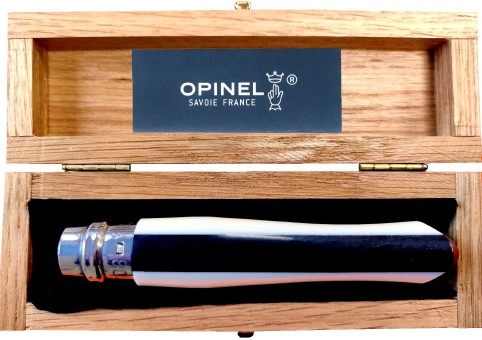
The Bone and Ebony model has a laminated handle consisting of an ebony slice caught between two bone slices. The model is delivered in an oak case with a leaflet and a sheath. The blade is made of polished stainless steel. Because of a very limited production run, the model is very hard to find.
The copies are not numbered.
Year of production: 2017 - 100 copies
Wood quality: 5/5
Hardware quality: 1/5
Rareness: 5/5
Value: €300
Value change: +
Hornbeam (Charme)
Hornbeam models are many. Only the raw hornbeam model produced in 2,500 copies on behalf of Nature&Découvertes is considered here. The blade is stainless. It is delivered in a pillow box.
The copies are not numbered.
The other Hornbeam models have sublimated handles and form many colored special series.
Year of production: 2018 - 2,500 copies
Wood quality: 2/5
Hardware quality: 1/3
Rareness: 3/5
Value: €40-€60
Value change: =

Hornbeam keeps its light color. It therefore lends itself well to colored models.
Ironwood, Sonoran Desert (Bois de fer d'Arizona)
The Sonoran Desert Ironwood model, also called Arizona, comes in an oak pencil case with a leaflet and a sheath. The blade is copper-colored stainless steel. It is not polished.
1,100 copies were made. The copies are numbered perpendicular to the blade. A few hundred copies were exported.
Although the model is sold out, it is still fairly easy to find because a few collectors bought several copies that are put back on the market in dribs and drabs. As a result, the copies sell today for about three times the Opinel retail price, a ratio still off the ten times observed for comparable models sold out for long.
The Arizona model remains the last grand number 8 manufactured by Opinel to this day. The fitting of the present ferrule of circumference too truncated and randomly incorrectly positioned is unfortunate.
Year of production: 2021 - 1,100 copies
Wood quality: 5/5
Hardware quality: 1/3
Rareness: 3/5
Value: €350-€550
Value change: =

The Sonoran Desert Ironwood model offers a large diversity of copies. Yet it darkens with age and the differences between copies won't keep so marked.
Juniper (Genevrier)
The Juniper model was delivered in a beechwood pencil case with a leather case, in a transparent plastic pillow box with an explanatory sheet or in bulk. Today, a few copies are available in bulk but the current production seems random. It is difficult to estimate the total production. The copies in a pencil case are hard to come by, they probably have not exceeded a few hundred.
The blades of copies in a pencil case are stainless and polished. Those of copies in a pillow box or in bulk are just stainless.
The copies are not numbered.
Year of production: before 2016 (?) for copies in a pencil case
Wood quality: 1/5
Hardware quality: 2a/3 (?)
Rareness: 4/5
Value: €200-€250 for copies in a pencil case
€100-€150 for copies in a plastic pillow box
€50-€80 for copies in bulk
Value change: =

Letterwood
See Snakewood.
Locust, Black (Robinier)
Black locust gave rise to the manufacturing of 300 copies in partnership with the Autour du couteau cutlery shop. The blade is unpolished stainless steel.
The copies are numbered parallel to the blade. The number is preceded by the name of the cutlery shop "Autour du COUTEAU". The copies come with a handwritten note by Christian Moulin then manager of the cutlery shop.
Year of production: 2011 - 300 copies
Wood quality: 2/5
Hardware quality: 3/3 (?)
Rareness: 5/5
Value: €40-€50
Value change: =

Maple, Field (Érable champêtre)
During the 20th century maple was alternately used with other common species (cherry, ash, beech). Yet maple may have been the least used wood among them. The maple copies were delivered in bulk. The handles are covered with an orange-yellow varnish that masks the off-white color of the maple wood. The safety ring doesn't have a notch for locking the blade in the folded position. The blade is made of carbon steel.
As far as I could observe, a new genuine maple copy would be rarer than a copy of practically all the models listed on this page, including the most fine woods. Especially since maple has never been part of the Bois de France series. Hence, given its great rarity, the original model certainly is largely undervalued. Perhaps because, once covered with the Opinel varnish, maple wood looks like thus varnished beech wood. A trained eye will however make the difference.
Year of production: before 1990
Wood quality: 2/5
Hardware quality: 2a/3
Rareness: 5/5
Value: €40-€50
Value change: =

The maple family comprises more than two hundreds species, all of which have similar woods. Opinel probably used wood from European maples. Although sycamore maple is sometimes mentioned, field maple seems to me to be a better match in color and wood quality.
Maple, Hard (Érable à sucre)
Maple gave rise to the manufacture of a small series in collaboration with the L.L. Bean cutlery store in the United States. The maple wood used to make this model would come from the bottom of the Moosehead Lake in the state of Maine where it would have remained down at the bottom for more than a century.
The model was delivered in a specific cardboard window box. The blade is unpolished stainless steel. The number of manufactured copies was not communicated.
Year of production: 2017
Wood quality: 2/5
Hardware quality: 1/3
Rareness: 5/5
Value: €100-€150
Value change: =

Since that maple wood comes from the state of Maine in the USA, I assume it is hard maple.
Marblewood (Bois serpent)
The Marblewood model comes in a blue cardboard box with a round sticker and an explanatory sheet. The blade is stainless and polished.
The model was produced in 8,250 copies. The copies are not numbered.
Year of production: 2022 - 8,250 copies
Wood quality: 4/5
Hardware quality: 1/3
Rareness: 2/5
Value: €40-€70
Value change: =

Note: On the explanatory sheet Opinel calls this wood Snakewood, i.e. the translation of French "Bois serpent". Yet snakewood in English is the name of a different wood whose French name is Amourette. As it happens, this wood is named Marblewood in English. Note that Opinel also made a knife out of snakewood that can be seen below.
Morado (Palissandre santos)
As far I know, Opinel used morado instead of real rosewoods without stating it, possibly because morado is called "Palissandre santos" in French. In particular, morado copies also bore the "Palissandre" sticker. The morado copies were thus delivered in the same forms as the rosewood copies.
Although morado wood can grow a beautiful grain, it generally is of lower quality than that of most rosewoods.
The number of manufactured morado copies seems to be a low fraction of the rosewood copies. About 20% of the copies sold as rosewood may have been made of morado in reality.
Last, probably due to the difficulty of discriminating between morado and certain rosewoods, the value of morado copies does not differ from that of rosewood copies.
Year of production: (?)
Wood quality: 2/5
Hardware quality: (?)
Rareness: 4/5
Value: €70-€160
Value change: =

This copy is made of morado. Telling between morado and rosewood is a matter of expertise.
Oak, European (Chêne pédonculé)
European oak has recurrently been used by Opinel. The production of European oak models spans many years. Copies have been delivered in a beech pencil case with an explanatory sheet, in a cardboard window box, in a pillow box, or in bulk. Copies in an oak case can also be found. The blades are stainless. In a pencil case, the blades are either polished or black with black hardware. Thousands of copies have been manufactured.
None of the diverse copies have been numbered.
European oak copies often have very small dents on the handle, probably due to the manufacturing process.
The European oak model was one of the Bois de France. It has also given rise to a couple of special series Animalia and Hermione.
Year of production: NA
Wood quality: 1/5
Hardware quality: NA
Rareness: 1/5
Value: €19-€43-€90 according to version or delivery
Value change: =

Oak, Holm (Chêne vert)
The Holm Oak model was delivered in an oak case with a "Chêne vert" sticker and a sheath. The blade is stainless and polished. Very few copies were made. The model isn't common.
The copies are not numbered.
Year of production: 2005 (?)
Wood quality: 2/5
Hardware quality: 3/3 (?)
Rareness: 5/5
Value: €100
Value change: =

Olive (Olivier)
Olive has recurrently been used by Opinel. The production spans many years. The copies have been delivered in bulk, in a pillow box or in a cardboard window box. Some copies have been packaged in a beech pencil case with an explanatory sheet and a leather case. The blade is stainless.
Those series have not been numbered.
The olive copies often have very small dents on the handle, probably due to the manufacturing process.
The Olive model was one of the Bois de France.
Nature&Découvertes had a series in a beech case with black hardware and an explanatory sheet manufactured by Opinel. The handle has a leather strap. It was manufactured in 1,000 copies. These copies are numbered perpendicular to the blade.
Year of production: NA to Opinel production
2017 for Nature&Découvertes copies - 1,000 copies
Wood quality: 4/5
Hardware quality: NA to Opinel production
1/3 to Nature&Découvertes copies
Rareness: 1/5 to Opinel copies
4/5 to Nature&Découvertes copies
Value: €19-€40-€150 for Opinel copies according to the delivery
€200-€300 for Nature&Découvertes copies
Value change: =

Olive offers a very large diversity of copies. A few copies display striking patterns.
Padauk (Padouk)
The Padauk model replaced the Bubinga model. It currently comes in a blue cardboard box with corner sticker, leaflet and sheath. A past run was delivered in a cardboard drawer box. A round sticker on the drawer reads "PADOUK" to distinguish it from other models delivered in the same box. The blade is stainless and polished. Production is currently ongoing and the number of copies manufactured is in the thousands.
The copies have not been numbered.
Year of production: since 2017
Wood quality: 2/5
Hardware quality: 1/3
Rareness: 1/5
Value: €25
Value change: =

Padauk loses its reddish hues over the years. It then tends towards a brown wood. As the hardware is classic, the Padauk model will be difficult to tell in the future without the elements originally coming with it.
Palm, Bataua (Palmier noir)
The Bataua Palm model comes in a yellow/blue cardboard box with an explanatory sheet. The lid is illustrated with palm trees. The blade is stainless steel with an anthracite gray finish.
The model was produced in 6,250 copies. The copies are not numbered.
Year of production: 2022 - 6,250 copies
Wood quality: 3/5
Hardware quality: 1/3
Rareness: 2/5
Value: €100-€150
Value change: =

Note: On the explanatory sheet Opinel calls this wood Black Palm, i.e. the translation of French "Palmier noir". Yet Black Palm in English refers to different species of palms. As the explanatory sheet reads this palm is also called Patawa. As it happens, it is more precisely named Bataua Palm (or Patawa) in English.
Pink Ivory (Ivoire rose)
The Pink Ivory model comes in a tan cardboard box with an explanatory sheet. The hardware is dark steel gray. It is covered with a titanium-aluminum coating. The blade is also coated.
The titanium-aluminum coating is a kind of finish that modestly adheres to steel. Using this model may cause the coating to peel off. It then scales off from the blade.
The model was produced in 400 copies, all numbered perpendicular to the blade.
Year of production: 2013 - 400 copies
Wood quality: 5/5
Hardware quality: 2a/3
Rareness: 5/5
Value: €600-€800
Value change: +

Over the years, Pink Ivory loses its initial pink or orange tint to get dark red then brown. Since the Pink Ivory model was manufactured in 2013, the vast majority of the copies have lost the pink hue today. Some few are even almost brown. Fortunately, the numbering and special hardware will always make the Pink Ivory model easy to tell. The photo above was retouched to restore the original colors; the copy is much darker in reality.
Plane, London (Platane)
The London Plane model comes in a blue cardboard box with a corner sticker and an explanatory sheet. The blade is stainless.
The model was produced in 6,000 copies. The copies are not numbered.
Previously, a first plane model was manufactured into the Pétanque special series. The handle and the blade were illustrated with players. The Pétanque model was delivered in an orange pillow box duplicating the handle drawing. It's not common.
Year of production: 2020 - 6,000 copies
Wood quality: 1/5
Hardware quality: 1/3
Rareness: 2/5
Value: €40-€60
Value change: =

Purple Heart (Amarante)
The Purple Heart model comes in a beechwood pencil case with an explanatory sheet. The blade, ferrule and virobloc are black. They are stainless.
The model was initially released in partnership with the Brossard cutlery shop. 300 copies were then manufactured. Next Opinel resumed the model production on its own behalf. An additional 3,500 copies were thus manufactured. There were therefore 3,800 copies of this model put on the market.
Only the Opinel explanatory sheet different from the Brossard explanatory sheet tells the run. There is no difference in value between the two runs.
The copies are not numbered.
Year of production: 2020 - 3,800 copies
Wood quality: 4/5
Hardware quality: 1/3
Rareness : 3/5
Value : €160-€210
Value change: =
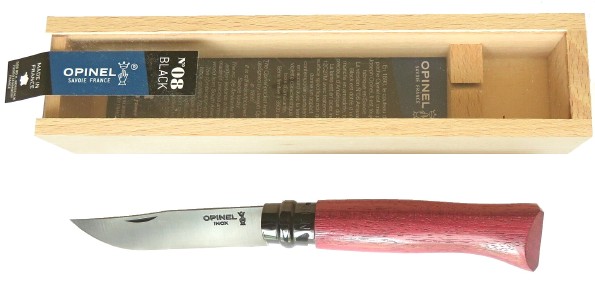
Purple Heart loses its purple tint over the years. It becomes brown. Although the Purple Heart model is rather recent, some copies have already lost their purple hues. Without the original elements coming with it, the Purple Heart model might get difficult to tell in the future. Black hardware will however cut down the odds of being mistaken. The photo above was retouched to restore the original colors; the copy is a little darker in reality.
Rosewood (Palissandre)
The Rosewood model has been available in many runs. In particular, rosewood has been used in quite a few special series. The copies have been delivered in a pillow box, in a tan cardboard box with a leaflet and a sheath, in a plywood/fir case with red molded bottom and a "Palissandre" sticker, in an oak case with red molded bottom with a "Palissandre" sticker, a leaflet and a sheath, in an oak case with a "Palissandre" sticker, a leaflet and a sheath, or in a beech pencil case with a "Palissandre" sticker, a leaflet and a leather case. Although rare copies with unpolished blades can be found, the blades are generally stainless and polished. They bear several markings used by Opinel.
The leather cases sold with the rosewood model are of high grade. The leather is full-grain, the tanning is vegetable and the stitch is saddle. Cases may comprise a sharpening steel in a sub-case stitched on the side. Finally the leather cases are numbered by imprint on the belt loop.
Production spans years. It was substantial. The first copies were made of Honduran rosewood. East Indian rosewood has followed after. Thus the model is easy to come by. There is no difference in value between the species. Yet it should be noted that listings incorrectly describing a bubinga copy as rosewood come about from time to time. The presence of the “Palissandre” sticker on the handle helps identification.
The copies have not been numbered.
The best-known rosewood special series are: Ligne palissandre, Christopher Colombus, History 2000, 50 ans du débarquement, Albertville 92 and Fanfoué. Often numbered, some series are particularly rare.
Year of production: NA
Wood quality: 3/5 or 4/5
Hardware quality: NA
Rareness: 3/5
Value: €70-€160 according to the delivery
Value change: =

This copy is made of Honduran Rosewood. East Indian Rosewood is generally darker with purple hues.
Snakewood / Letterwood (Amourette)
The Snakewood model comes in a tan cardboard box with an explanatory sheet. The blade is stainless and polished.
The Snakewood model was manufactured in 1,500 copies. However, a number of copies had few or no black patches and would have been shipped back to Opinel by retailers or customers. Some collectors claim that more than half of the copies were thus "disappointing". If these claims are true, there are far fewer copies in circulation than the 1,500 copies produced. A few hundred copies would be a number consistent with the observed rareness.
The copies without patches that remain in circulation are about half-valued because they little depart from other brown wood models. It's the snake-skin figure that makes the specialness of the wood and the value of the snakewood model.
The copies are not numbered.
Year of production: 2012 - 1,500 copies
Wood quality: 5/5
Hardware quality: 3/3
Rareness: 5/5
Value: €650-€700 for figured copies
€300-€350 for figureless copies
Value change: +

Snakewood darkens with age. Black patches remain but they are less contrasted. Since the Snakewood model was manufactured in 2012, almost all copies have darkened today. The photo above was retouched to bring out the patches. In reality, the handle is darker and the patches less manifest. A still light brown copy without patches was added.
Three Continents (Trois continents)
The Three Continents model has a laminated handle consisting of alternating ebony and rosewood strips separated by thin boxwood strips. The rosewood could be morado. The model is delivered in a blue cardboard box with an explanatory sheet and a sheath. The blade is stainless and polished.
4,000 copies were numbered. Yet the number of manufactured copies is unknown because numberless copies were made. The numbered copies are numbered perpendicular to the blade.
Year of production: 2015 - more than 4,000 copies
Wood quality: 3/5 and 5/5
Hardware quality: 2a/3
Rareness: 4/5
Value: €300-€500 for numbered copies
€250-€300 for numberless copies
Value change: =

Tulipwood (Bois de rose)
The Tulipwood model was manufactured in at least two runs. It was delivered with a leaflet in a plywood/ash case with red molded bottom, with a leaflet and a sheath in an oak case with red molded bottom, or with a leaflet and a sheath in an oak case. "OPINEL" is stamped on the handle of the first copies. A run was also delivered in a cardboard drawer box with sheath and leaflet. A round sticker on the drawer reads "BOIS DE ROSE" to distinguish it from other models delivered in the same box.
All runs offer polished stainless steel blades but with different markings: laser etching on the first run then stamping on the next ones.
There is no difference in value between the copies in a wooden case. On the other hand, the cardboard boxed copies are less valued.
The copies are not numbered. The number of manufactured copies is unknown. However, given the great rareness of the model, a total production fewer than a thousand copies can be estimated.
Two things are worth noting:
First, although tulipwood is fairly easily identifiable, listings incorrectly describing a copy as "Bois de rose" do occur from time to time. In particular, some African woods are improperly called "Bois de rose" when they are not. So be careful. Genuine tulipwood copies are among the rarest Opinel and the number 8 is especially difficult to find.
Second, the tulipwood handles all have very small dents, probably due to the handling during manufacture. This piece of information may help identify genuine tulipwood copies.
Year of production: 2009 for the copies in an oak case with leaflet and sheath
before 2009 for the copies in wooden case with red molded bottom
Wood quality: 4/5
Hardware quality: 2b/3 to the copies in an oak case with leaflet and sheath
2a/3 to the other copies
Rareness: 5/5
Value: €300-€450
Value change: =

Walnut (Noyer)
Walnut has recurrently been used by Opinel. The production of walnut models spans many years. The copies have been delivered in bulk, in a pillow box, in a cardboard window box, or in a cardboard drawer boxes with red molded bottom. The blade is stainless. In addition, it is polished for copies in cardboard drawer boxes with red molded bottom. Some copies were also delivered in a beech pencil case with an explanatory sheet and a black hardware.
Walnut copies very often have very small dents on the handle, probably due to the manufacturing process.
Opinel also made a model from Noce Nostrano, an Italian variety of walnut. The model, marketed in Italy only, was delivered in a velvet plastic case with an explanatory sheet. The number of manufactured copies was not communicated. The model is not common.
None of the diverse copies have been numbered.
The Walnut model was one of the Bois de France. Walnut was also used in a few special series like La Route de l'Opinel.
Year of production: NA
Wood quality: 1/5
Hardware quality: NA
(?) to the NoceNostrano model
Rareness: 1/5 to common copies
4/5 to Noce Nostrano copies
Value: €19-€60
€200-€250 for the Noce Nostrano model
Value change: =

Opinel has used several varieties of walnut ranging from blond to brown. If it is not too dark to begin with walnut ages well, developing deep reddish hues barely visible when young.
Wenge (Wengé)
The Wenge model comes in a blue cardboard box with a corner sticker and an explanatory sheet. The blade is stainless and black as well as the rest of the hardware.
The model was produced in 3,500 copies. The copies are not numbered.
Year of production: 2017 - 3,500 copies
Wood quality: 2/5
Hardware quality: 1/3
Rareness: 4/5
Value: €200-€400
Value change: =

Workshop (Atelier)
The Workshop model consists of a walnut body and an ebony heel separated with a very thin maple strip. It is delivered in a blue cardboard box with corner sticker or in a beech pencil case. The cardboard box and the pencil case contain different explanatory sheets. The blade is stainless in the cardboard box and the hardware is black in the pencil case. A few copies have been marketed with a polished blade.
The copies have not been numbered.
Year of production: NA
Wood quality: 1/5 and 5/5
Hardware quality: 1/3
Rareness: 1/5
Value: €59 (€35-€45)
Value change: =

Zebrali
See Beli.
Other woods
It may be that Opinel has also used chestnut wood, elm, pearwood, plumwood, or sipo/utile to make number 8 knives but I have no reliable information on those models.
Opinel is a registered trademark.
© 2026 - coteopinel - All rights reserved